
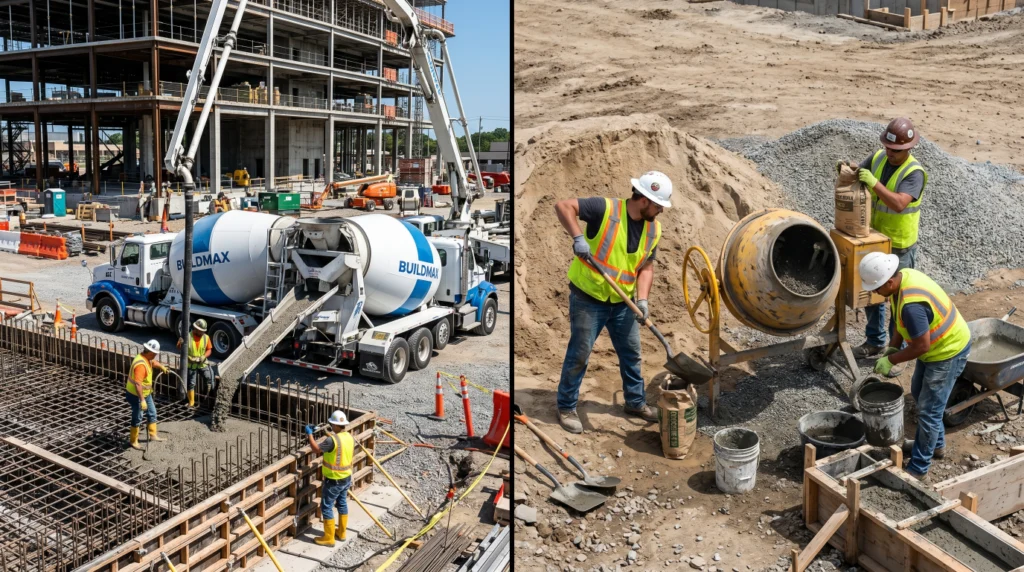


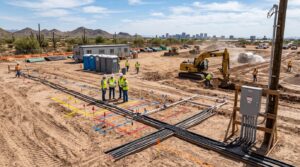
Concrete is one of the most common materials used in building. It is made from three main things: cement, water, and small stones or sand called aggregates. In construction, there are two main types of concrete: ready-mix concrete and site-mixed concrete. Ready mix concrete is made in a factory called a batching plant and then brought to the construction site ready to use.
Site mix concrete is made directly at the building site by mixing cement, sand, gravel, and water using machines or by hand. Concrete is very important because it helps make buildings strong, safe, and long-lasting, whether it is a house or a large project. If you are in Phoenix, AZ, we work with both types of concrete on projects across the Valley, so we are here to help you.
What is Ready Mix Concrete?
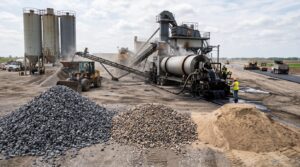
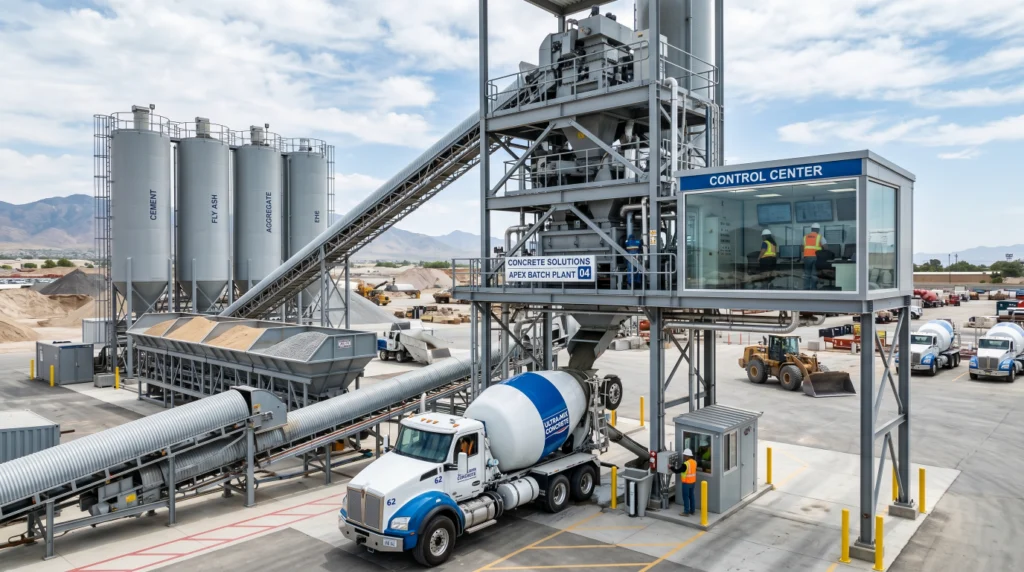
Ready mix concrete, also known as RMC, is concrete that is produced at a centralized batching plant and then delivered to your construction site in a transit mixer truck, ready to pour. A computerized plant measures and mixes cement, sand, aggregates, water, and additives in exact amounts based on project requirements, including strength levels like 3000, 4000, or 5000 PSI.
What is Site Mix Concrete?
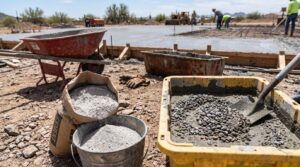
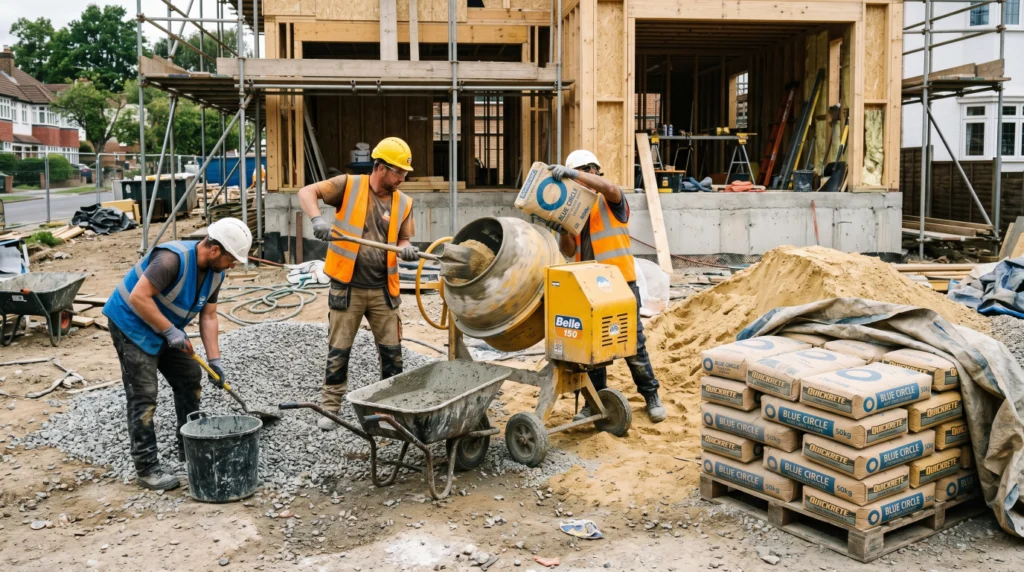
Site mix concrete is exactly what the name suggests. Cement, sand, coarse aggregate, and water are measured and mixed directly at the construction location, either by hand or using a portable drum mixer. Workers mix concrete on site by hand or with a small mixer, using buckets or shovels. The mix ratio (like 1:2:4 or 1:1.5:3) depends on experience rather than precise measurement.
Key Differences Between Ready Mix and Site Mix Concrete
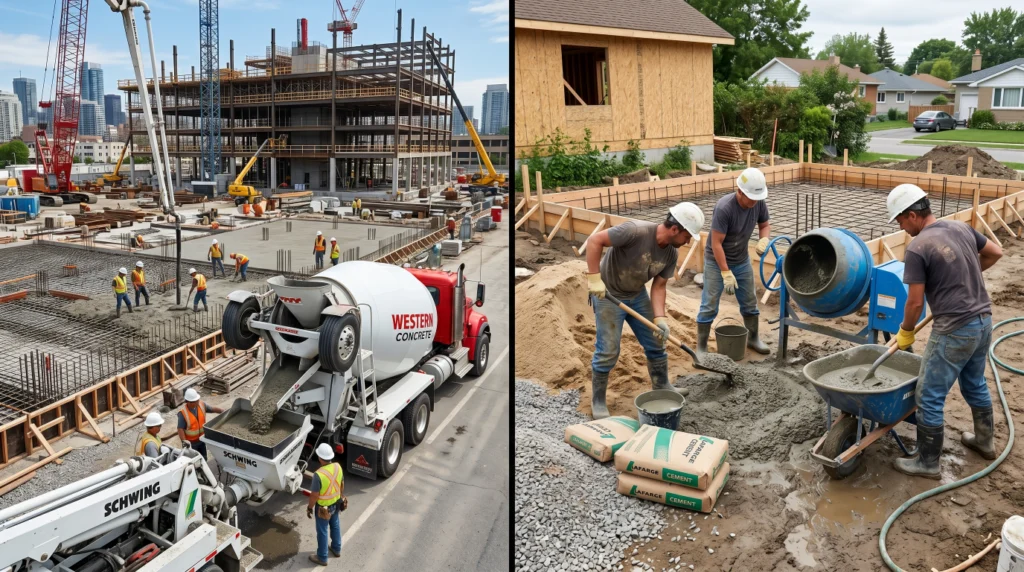
Ready mix is pre-made in a plant and delivered ready to use, while site mix is prepared manually on the construction site.
Quality and Consistency
This is where the two methods differ most. Ready mix concrete is made under strict quality control, with every ingredient weighed precisely, so each batch matches the last. Site mix depends on workers and manual measurements, which are hard to keep identical. Even one extra gallon of water per cubic yard can cut strength by 150 to 200 PSI. For columns, beams, and foundations, that inconsistency can create weak spots that affect the whole structure.
Time Efficiency
Ready mix arrives ready to pour, with no setup, mixing, or waiting. Studies show it can cut project timelines by up to 60% compared to on-site mixing. Site mixing is slower, since workers must set up equipment, measure, mix, and repeat batch after batch. For large pours, that can stretch on for hours or days.
Cost Comparison
Ready mix usually costs around 20% more per cubic meter, and that upfront cost is real. But site mixing carries hidden costs: a drum mixer to buy or rent, extra labor, material storage, and more wastage from imprecise mixing. Add those up and the gap narrows, especially on medium to large projects. For very small jobs like patching a driveway, bagged site mix is often cheaper since it avoids ready mix minimum truck fees.
Strength and Durability
Ready mix delivers reliable, specified strength, whether you need 3000 PSI for a home slab or 5000 PSI for a commercial floor. The batching plant guarantees the spec. Site mix can reach the same strength in theory, but only with a perfect ratio and tight water control on every batch, which is hard to maintain through a long pour. The result is often uneven strength across the structure.
Equipment and Labor Requirements
Ready mix asks little of your site. You just need a crew to spread and finish, since the mixing is already done, which frees up workers and lowers headcount. Site mixing is labor-intensive, needing dedicated workers plus a drum mixer, water supply, and material storage. On large projects, that adds complexity and raises the risk of delays.
Advantages of Ready Mix Concrete
Ready mix concrete delivers high-quality, consistent results because the entire production process happens in a controlled factory setting. There is no room for human error in the mixing. Because the concrete arrives ready to pour, your team can focus on placement and finishing rather than spending time and energy on mixing. Batching plants calculate exact volumes, so you order what you need and get precisely that.
Manual on-site mixing almost always results in some waste from incorrect proportions or leftover batches. The durability of ready mix concrete tends to be better over the long term because the water-cement ratio is controlled precisely. Lower water-cement ratios produce stronger, more durable concrete.
Disadvantages of Ready Mix Concrete
Ready mix concrete depends entirely on transportation. If the truck is delayed in traffic or the road to your site is narrow or unpaved, your pour can be compromised. The concrete does not wait for anyone.
Once the truck arrives, you have a limited window, usually 90 minutes, to pour and finish the concrete before it starts setting. If your crew is not ready or there are unexpected site issues, you may lose the batch. The upfront cost per cubic meter is higher than site mixing, which can feel significant for smaller projects.
Advantages of Site Mix Concrete
Site mix concrete is well-suited for small residential projects, repairs, and renovations where the volume needed is low and the budget is tight. It gives you flexibility to adjust the mix on the spot. If a section of the job calls for a slightly different consistency, you can make that change immediately without waiting for a new truck. It does not require truck access to your site. For remote locations or areas with narrow roads where a transit mixer cannot reach, site mixing is the only viable option.
Disadvantages of Site Mix Concrete
Inconsistent quality is the biggest problem with site mixing. Over a large pour, these small differences add up and can create structural weaknesses. For large foundations, walls, or slabs, site mixing takes much longer than ready mix delivery, which directly increases labor costs and project timelines.
Poor mixing technique, incorrect ratios, or too much water in the mix can significantly reduce the final strength of the concrete. Material wastage is also higher with site mixing due to imprecise measuring and leftover batches.
When Should You Use Ready Mix Concrete?
Ready mix concrete is the right choice for large construction projects like commercial buildings, warehouses, and apartment complexes. Any project that requires high volume pours benefits from the speed and consistency of ready mix. It is also the go-to option for high-rise buildings, and infrastructure projects where structural integrity is non-negotiable and every pour must meet exact strength specifications.
Projects that require high precision, such as prestressed concrete elements or post-tensioned slabs, should always use ready mix because achieving the correct water-cement ratio manually is nearly impossible at scale.
When Should You Use Site Mix Concrete?
Site mix concrete makes the most sense for small home projects like building a backyard wall, patching a driveway, or laying a small concrete path. It works well for repairs and renovations where the volume needed is small and getting a ready mix truck to the location is impractical.
For remote construction sites that are far from any batching plant, site mixing may be the only feasible option. In areas with limited access for large trucks, setting up a small on-site mixing operation is more practical than coordinating deliveries.
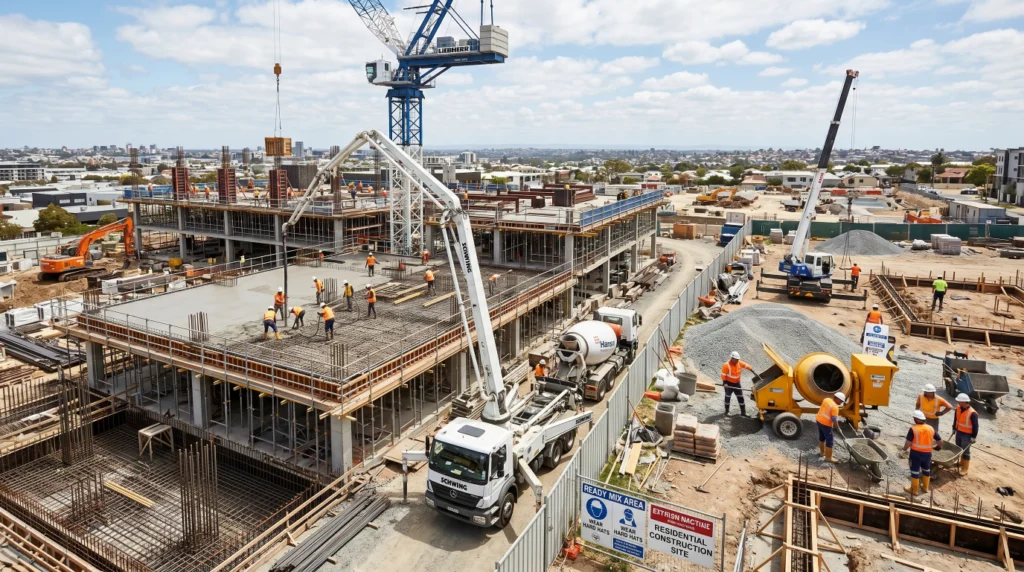
Which is Better: Ready Mix or Site Mix Concrete?
For most construction projects, ready mix concrete is the better choice. It delivers higher quality, greater consistency, faster progress, and less material waste. For anything involving structural elements, large volumes, or projects where strength specifications must be met precisely, there is no real competition.
Site mix concrete has its place for small, simple jobs where the volume is low, truck access is impossible, and cost is the primary concern. A homeowner laying a small garden path or patching cracks in a sidewalk does not need a ready mix truck.
Common Mistakes to Avoid When Choosing Concrete Type
One of the most common mistakes contractors make is using site mix on a project that is too large for it. Once the job exceeds a certain volume, the inconsistency of manual mixing becomes a real structural risk.
Another mistake is underestimating labor and time. Site mixing takes much longer than people expect, especially when the crew is small or the work is physically demanding. Delays compound quickly.
Some people also overlook quality control entirely, assuming that all concrete is the same as long as the right ingredients go in. The ratio, the water content, the mixing time, and the curing method all affect the final strength. Skipping quality control is how you end up with a slab that cracks within a year.
Need Concrete Done Right in Phoenix, AZ?
Choosing between ready mix and site mix is easier with an experienced contractor on your side. At S&S Paving & Construction in Phoenix, AZ we have built Arizona’s infrastructure since 1984, from site concrete and foundations to large commercial pours. Our team will look at your project, recommend the right concrete for the job, and deliver quality work on time and on budget. Contact us today or request your free estimate online and let’s build something that lasts.
Conclusion
Ready mix concrete and site mix concrete both have their roles in construction. But they are not interchangeable, and picking the wrong one for your project is a costly mistake.
Ready mix concrete wins on quality, consistency, speed, and long-term durability. It is the right call for any project where structural integrity matters and volume is significant. Site mix concrete is a practical, flexible option for small jobs, tight budgets, and locations where ready mix trucks simply cannot reach.
Frequently Asked Questions
Is ready mix concrete stronger than site mix concrete?
Ready mix concrete is produced in a controlled batching environment where every ingredient is measured precisely and the water-cement ratio is carefully maintained. Site mix concrete can theoretically reach similar strength levels, but inconsistent manual measuring, especially the tendency to add too much water, often results in lower and uneven compressive strength across different pours.
Which is cheaper, ready mix or site mix concrete?
On a raw material cost basis, site mix concrete is cheaper by roughly 20% per cubic meter. However, when you factor in labor costs for mixing, equipment rental, material wastage, and longer project timelines, the actual cost difference shrinks considerably.
Can site mix concrete match ready mix quality?
With highly skilled workers, precise measuring tools, and strict quality checks on every batch, site mix concrete can come close to ready mix quality. In practice, this level of consistency is very hard to maintain throughout a large pour, especially under time pressure and with varying site conditions.
What are the main uses of ready mix concrete?
Ready mix concrete is used in commercial and residential foundations, high-rise buildings, highways, bridges, airport runways, dams, tunnels, and any large infrastructure project requiring high volumes and precise strength specifications.
How long does ready-mix concrete last after it is delivered?
Once the truck arrives, you usually have about 90 minutes to pour and finish ready mix concrete before it starts to set. Hot Arizona weather can shorten that window even more. This is why your crew and site should be fully prepared before delivery, so no batch goes to waste.
